Sunday, June 19, 2016

Buya Hamka, 1940.


"Maka sebelum kita maju dalam menentukan tujuan hidup, hendaklah kita pandai memilih mana yang cocok buat diri, jangan mana yang disukai saja. Anak muda kerapkali tidak insaf akan hal ini, karena darahnya masih muda dan panas.

Ada anak muda melihat orang lain senang makan gaji, dia hendak makan gaji, padahal yang lebih cocok dengan dia bukan makan gaji, tetapi berniaga. Ada pula yang melihat orang jadi wartawan atau pengarang, dia hendak jadi wartawan pula, padahal yang lebih sesuai dengan dirinya jika ia jadi petani. Ada pula pemuda yang hendak dibentuk oleh ayahnya menurut maunya saja, mau menurut kelayakan yang cocok dengan anak itu, ada pula yang karena pengaruh orang lain hilang timbangannya.

Tetapi ada golongan ketiga yang mempelajari pekerjaan sebelum ditempuhnya, menimbang sebelum berjalan dengan kemerdekaan pendapat dan akal, memakai pakaian yang sesuai dengan tubuhnya. Inilah yang paling benar, tetapi ini pula yang  sulit."

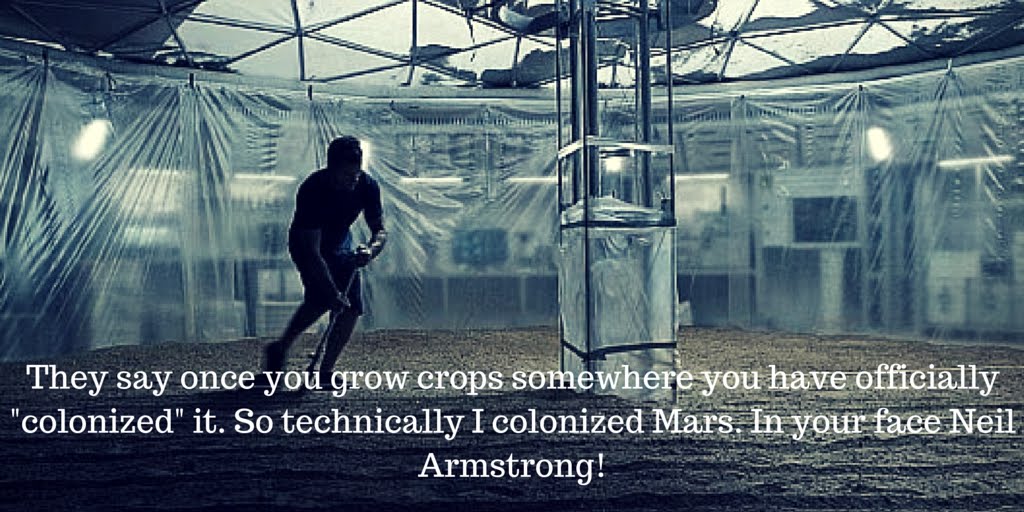
Fact-Checking “The Martian”: Can You Really Grow Plants on Mars?


I AM THE GREATEST BOTANIST ON THIS PLANET -Mark Watney in "The Martian"

In Ridley Scott’s movie, “The Martian,” Mark Watney, played by Matt Damon, gets caught in a sandstorm on Mars. He’s left for dead by his crew, who manage to escape the planet. To save himself, Watney needs to get in touch with NASA and arrange a rescue mission. In the meantime, he has to survive for a few hundred days—on a planet where nothing grows.

Unfortunately, Watney is apparently nowhere near where NASA just found water on Mars. But, fortunately, he is a botanist. Almost immediately, he heads back to NASA’s Martian base, MacGuyvers together a device that distills water from the air, and figures out how to grow potatoes, living off them and leftover food from NASA. But does the science stand up to scrutiny?

We spoke to Andy Weir, who wrote the novel on which the movie “The Martian” is based. He did copious research to make sure the novel is as scientifically accurate as possible, and was in frequent contact with Drew Goddard, who adapted the book into a screenplay, to transfer that accuracy on screen. Weir also said he was in frequent contact with the crew during the shoot to consult on technical questions.

And, yes, it is possible to grow plants on Mars—kind of. Alone, Martian soil doesn’t have the necessary elements for plant life. “The main thing that’s not in Martian soil is a bunch of nutrients and biological materials that plants rely on to grow,” Weir says. “It’s not there because, obviously, there’s no life on Mars.”

So to get biological material into Martian soil, Watney uses the only spare biological material he has: astronaut poop. He mixes it in with the Martian soil, plants some potatoes that NASA had sent up with his crew, and, voila, you have plant life on Mars.

Watney rehydrated his crew’s feces and mixed it with his own. That way, he could take advantage of the nitrates and other elements from the crew’s feces, and still have the bacteria from his own feces into it. “So what he ended up with was a big tub of shit that only has his pathogens,” Weir says. Good advice if you’re ever stuck on Mars.

The next question is whether a person can actually live off practically only potatoes for hundreds of days, but that’s fodder for another article.

NO PLANT. NO FOOD. NO LIFE.

Memori: Student Summit ITB 2016.

Student Summit ITB 2016.