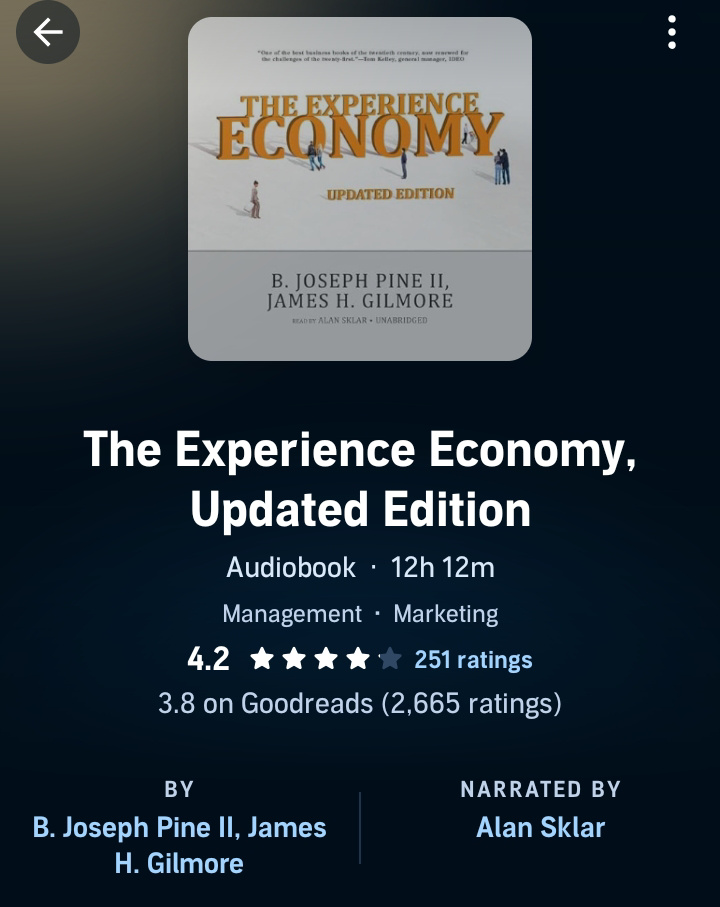
The most captivating revelation in "The Experience Economy" is the assertion that goods and services have become commoditized, necessitating a shift where businesses must stage memorable events to create distinct economic value. The authors provocatively argue that "work is theatre," urging every employee to act with intention and every business to script its operations as a performance that engages the guest's emotions. Furthermore, they introduce the concept of "customer sacrifice," defining it as the gap between what a customer accepts and what they truly desire, which can only be bridged through deep mass customization. Ultimately, the book concludes that the economy's final frontier is the "Transformation Economy," where the customer becomes the product and businesses charge for the life-changing outcomes they help achieve
I would like to share with you about the insights and key takeaways from this book. So, here they are, happy learning and enjoying!
Preview to the Updated Edition: Beyond Goods and Services
The updated edition opens with a stark declaration: "Goods and services are no longer enough" to sustain economic prosperity. The authors argue that the advanced world's economic doldrums following the 2008 financial crisis resulted largely from a failure to experientially innovate. While the Industrial Economy and Service Economy once fueled growth, they have now faltered, with manufacturing becoming automated and services commoditized. To create new jobs and wealth, businesses must shift to the "staging of experiences" as a distinct form of economic output, moving beyond the mere delivery of services.
The text contrasts the success of experience-based businesses with the decline of traditional retailers. For instance, while many retail chains perished by focusing solely on merchandising finished goods, Build-A-Bear Workshop flourished by turning the production of stuffed animals into an engaging "retail factory experience". Similarly, Apple is cited as a prime example of the Experience Economy, having designed its retail stores not just to sell goods but to offer a social experience akin to a "boutique hotel," resulting in sales per square foot significantly higher than typical retailers.
A key insight is the "Geek Squad" model, which demonstrates that "work is theatre." Starting as a small task force, the Geek Squad expanded to thousands of agents by treating computer repair as a performance. Their "Special Agents" wear uniforms and drive "Geekmobiles," transforming a mundane service call into a memorable encounter. This exemplifies how even fragmented service industries can create tangible value by treating their work as a stage and their employees as actors.
The authors identify four specific value-creating opportunities for the future. First, businesses must embrace "mass customization" to produce only and exactly what individual customers want, thereby reducing "customer sacrifice"—the gap between what a customer settles for and what they truly desire. Second, companies should direct their employees to act, investing in rehearsal and performance skills to turn functional activities into memorable events.
Third, businesses should find ways to "explicitly charge for time," as time is the currency of experiences. The authors argue that if a company cannot create an experience worth an admission fee, it has not yet fully entered the Experience Economy. Finally, the book points to the "Transformation Economy" as the next phase, where companies charge for "demonstrated outcomes" that result from experiences, such as ensuring wellness in healthcare rather than just charging for visits.
Preview: Step Right Up
The original preview introduces the book as an escape from the "commodity mindset" where businesses compete solely on price. The authors warn that relying on low prices and economies of scale is a failing strategy in an era where goods and services are increasingly undifferentiated. They assert that experiences are a "distinct economic offering," as different from services as services are from goods, and that recognizing this distinction is essential for future economic expansion.
A significant portion of the text is dedicated to debunking the idea that information constitutes the foundation of the "New Economy." The authors state that "information is not an economic offering" because it "wants to be free." Value is created only when information is wrapped in services or experiences. Therefore, the substance of buying and selling must remain economic offerings, not raw intelligence.
The preview also addresses the future of employment, arguing that the Experience Economy will generate new wealth and jobs to replace those lost in agriculture and manufacturing. Just as technology reduced the need for factory workers, it opens opportunities for "experience stagers." The decline in traditional jobs is presented as a natural evolution, provided businesses remain free to innovate and create new types of economic value.
"Work is theatre" is introduced not as a metaphor but as a model for work. The authors argue that whenever workers interact with customers, they are acting, and the business is their stage. This perspective requires new techniques for performing, characterizing roles, and scripting work to effectively engage the audience.
Finally, the authors acknowledge the moral dimensions of this shift, using Las Vegas as an example of the "experience capital" that includes both designed entertainment and "prurient experiences." They argue that the moral emphasis should not be on *whether* to stage experiences, but on *what kinds* of experiences are staged. Businesses must concern themselves with the "ultimate aims of man" and strive to offer virtuous experiences that contribute to human flourishing.
Chapter 1: Welcome to the Experience Economy
This chapter establishes the "Progression of Economic Value" using the coffee bean metaphor. A commodity coffee bean is worth mere pennies; processed as a good, it costs a bit more; brewed as a service, it costs a dollar; but served in a five-star café as an experience, it commands $2 to $5. This demonstrates how wrapping an offering in an experience increases its value by orders of magnitude, distinguishing experiences as a fourth economic offering distinct from services.
The authors define an experience as a memorable event that a company stages to engage a customer in a personal way. Unlike services, which are intangible activities performed on behalf of a client, experiences are memorable events revealed over a duration of time. The buyer of an experience is a "guest," and the seller is a "stager". Walt Disney is credited with kickstarting this economy by creating theme parks that immersed guests in a story, a model now expanding into retail, dining, and other industries.
Technology is highlighted as a major driver, enabling new genres like video games and virtual worlds. The authors quote Andrew Grove, noting that the future of the computer industry lies not just in selling boxes (goods) but in delivering "lifelike interactive experiences". Traditional industries are also evolving, with restaurants offering "eatertainment" and retailers like Nike and Build-A-Bear engaging in "shoppertainment," using activities to draw customers into a physical environment.
The chapter introduces the concept of "ing the thing" to help manufacturers turn goods into experiences. By focusing on the activities associated with using the good—such as the "driving" experience for automakers—companies can shift attention from the product’s mechanics to the user’s interaction. This mindset opens new avenues for differentiation and allows businesses to "sensorialize" their goods, adding elements that engage the senses.
The evolution of the birthday party serves as a perfect illustration of the economic shift. Historically, parents baked cakes from scratch (commodities). Later, they bought pre-made mixes (goods), then ordered bakery cakes (services). Now, they outsource the entire event to places like Chuck E. Cheese (experiences), paying a premium for a memorable event rather than just the ingredients. This progression underscores how businesses can increase revenue by moving up the value chain.
Chapter 2: Setting the Stage
The authors describe "LAN Arenas" where gamers gather to play together, illustrating that even digital experiences crave physical social interaction. This highlights that the value of an experience often lies in the "game outside the game"—the social dynamics, taunts, and shared energy of a live event. It reinforces the idea that staging experiences is about "engaging" guests, not just entertaining them.
A key framework introduced is the "Four Realms of Experience," defined by guest participation (passive vs. active) and connection (absorption vs. immersion). The four realms are Entertainment (passive/absorption), Educational (active/absorption), Escapist (active/immersion), and Esthetic (passive/immersion). The authors argue that the most compelling experiences encompass all four realms, hitting the "sweet spot" in the center of the framework.
The Entertainment realm is the most familiar, where guests passively absorb the experience, such as watching a movie. The Educational realm involves active participation where the guest absorbs information to increase skills or knowledge. The Escapist realm involves active immersion, where the guest becomes an actor affecting the performance, such as in theme parks or casinos. Finally, the Esthetic realm involves passive immersion, where guests simply "want to be" in an inviting environment, like a gallery or a national park.
Authenticity is discussed in the context of "real" vs. "fake" environments. The authors argue that all experiences are real to the individual undergoing them, even if the setting is artificial. They distinguish between a "real fake" (like Universal CityWalk) that acknowledges its artificiality and a "fake fake" that tries to hide it. Successful esthetic experiences must be true to their own design intent to avoid being perceived as disingenuous.
To stage a rich experience, businesses are urged to ask design questions based on the four realms: What makes guests want to "be" (esthetic)? What should they "do" (escapist)? What should they "learn" (educational)? And how can they "enjoy" it (entertainment)? Addressing all four ensures a robust and memorable engagement that differentiates the offering from mere services.
Chapter 3: The Show Must Go On
The authors argue that experience orchestration is now as critical as product design, comparing modern business to a staged production where "real life's getting more like fiction each day." They emphasize that businesses must master the art of staging engaging events, as commercial activity increasingly resembles theatre. The first principle of staging is to envision a well-defined theme that creates a cohesive reality for the guest, much like the "Roman marketplace" theme of the Forum Shops in Las Vegas.
Effective theming involves more than just a motif; it requires a story that alters the guest's sense of reality, space, and time. The authors outline five principles: theme the experience, harmonize impressions with positive cues, eliminate negative cues, mix in memorabilia, and engage all five senses. Every detail, from the layout to the behavior of employees, must support the theme to create a consistent and immersive environment.
"Harmonizing impressions with positive cues" means ensuring that every signal—visual, aural, or behavioral—reinforces the theme. Conversely, "eliminating negative cues" is crucial to prevent distractions that break the illusion. The authors cite the importance of removing "anything that distracts from the theme," such as clutter or poor service, which they term "cracks in the mirror".
Memorabilia are presented not just as products but as physical reminders that extend the experience. Items like T-shirts or souvenir glasses allow the memory to be "relived" and shared, adding value long after the event has ended. Additionally, engaging all five senses increases the "bandwidth" of the experience, making it more memorable. The authors suggest that the more senses an experience engages, the more effective it is.
Finally, the chapter posits that "you are what you charge for." The ultimate test of an experience is whether customers are willing to pay admission. The authors challenge businesses to ask, "What would we do differently if we charged admission?" This question forces companies to focus on the value of the experience itself rather than giving it away to sell goods. Charging for time is the hallmark of a mature Experience Economy.
Chapter 4: Get Your Act Together
This chapter establishes Mass Customization as a primary route to the Experience Economy. It argues that efficiently serving customers uniquely turns a good into a service and a service into an experience. By "producing only and exactly what individual customers want," businesses can forestall commoditization and create offerings that are personal and difficult to replicate.
A key insight is the "automatic value shift": mass customizing a good automatically transforms it into a service, and mass customizing a service transforms it into an experience. This occurs because the customization process itself becomes a value-added interaction. For example, Dell turns the sale of a computer (good) into a service by customizing the hardware to the user's specific needs on demand.
The authors introduce the concept of "customer sacrifice," defined as the gap between what a customer wants and what they settle for. Mass customization aims to reduce this sacrifice. By identifying and eliminating the compromises customers make with mass-produced goods, businesses can create customer-unique value that fosters loyalty and satisfaction.
To achieve this, companies must replace the supply chain with a "demand chain," creating goods only in response to actual customer orders. This reduces inventory costs and waste while increasing relevance. The authors critique industries like the US auto sector for failing to embrace this model, noting that despite the potential, consumers still cannot easily mass customize a car to their exact specifications.
Mass customization creates "learning relationships." As a customer interacts with a company to tailor a product, the company learns their preferences, creating a barrier to exit. The customer would have to "reteach" a competitor, making loyalty sticky. This relationship is the foundation for sustainable growth in a world of saturated standard goods.
Chapter 5: Experiencing Less Sacrifice
Deepening the concept of customer sacrifice, this chapter explains that sacrifice is not just dissatisfaction but the difference between what a customer "accepts" and what they "truly desire". Every time a customer has to alter a suit or wait for service, they experience sacrifice. The goal is to identify these gaps and eliminate them through customization, asking, "What one dimension of sacrifice, if eliminated, would create the greatest value?".
The authors distinguish between customer satisfaction (meeting expectations) and sacrifice. High satisfaction scores can be misleading if sacrifice is high; a customer might be "satisfied" with a flight that arrives on time but still hate the seating. True loyalty comes from reducing the sacrifice involved in the experience, essentially lowering the non-monetary "price" the customer pays in terms of hassle and time.
The "3-S Model" is alluded to, involving Satisfaction, Sacrifice, and Surprise. While satisfaction is passive, "surprise" is active and creates a memory. However, surprise is hard to sustain, so the focus must remain on continuously reducing sacrifice. By tailoring offerings to the individual, companies remove the need for the customer to adapt, creating a seamless fit.
Mass customization is the tool for this reduction. The authors argue against "variety" (giving many choices of standard goods) in favor of true customization (giving exactly what is wanted). Variety often increases confusion and sacrifice, whereas customization simplifies the process. This shift requires a continuous "loop of learning" to anticipate customer needs.
Ultimately, focusing on "experiencing less sacrifice" moves a company beyond selling goods and services to becoming a partner in the customer's life. By helping customers achieve their goals with minimal friction, businesses build deep, resilient relationships that are far more valuable than transactional volume.
Intermission: A Refreshing Experience
The Intermission consolidates the "3-S Model" into a framework for enhancing customer relationships: Satisfaction, Sacrifice, Surprise, and Suspense. It emphasizes that while satisfaction is about meeting expectations, reducing sacrifice is about minimizing what the customer concedes. "Suspense" is introduced as a vital element often missing in business; unlike predictable services, suspense creates anticipation and engagement.
The authors reiterate that customers no longer buy for mere function but for the "memorable events surrounding those services." This requires a shift in mindset from operations to orchestration. Businesses must realize they are in the business of making memories, and that "there's new work to do"—work that involves engaging guests and performing on stage.
The concept of "paying admission" is revisited as a litmus test for value. If customers are willing to pay just to enter or participate, the business has successfully created a valuable experience. This is the ultimate goal of the framework: to create something so engaging that it is worth paying for in its own right.
Consistency is highlighted as key to managing these elements. A single bad interaction can destroy the trust built over time. Therefore, the "new work" requires that every worker understands their role in the larger production. The intermission serves as a bridge, preparing the reader for the detailed discussion of "Work is Theatre" in the subsequent chapters.
Chapter 6: Work Is Theatre
This chapter posits that "work is theatre" is not a metaphor but a descriptive model. Whenever a worker is in front of a customer, they are acting, and the workplace is a "performance stage." Workers must transition from simply "doing" tasks to "performing" roles, acting with intention. The authors invoke Stanislavski’s method, urging workers to act with a purpose described by the phrase "in order to...".
Work should have a dramatic structure with a beginning, middle, and end. Sales calls, for example, should be scripted as "sales scenes" with a climax and a dénouement. Without this structure, interactions become monotonous. The authors emphasize the importance of rhythm and tempo; a FedEx employee rushes to convey speed, while a waiter moves with grace. These choices distinguish engaging performances from dull ones.
Characterizing the role is essential. Workers must assume the "behavior, idiosyncrasies, thoughts, and personae" of their role, which requires preparation and rehearsal. The authors critique the lack of rehearsal in business compared to the theatre, noting that "actors prepare" while workers are often thrown onstage unprepared. Companies must invest in rehearsing scenarios to ensure high-quality performances.
The chapter cites effective business actors like Warren Buffett and Ronald Reagan, who understood they were constantly onstage. It urges all workers, from executives to frontline staff, to see themselves as actors. By designating the workplace as a stage ("This is my stage"), workers are forced to consider the audience (customer) in every decision, transforming mundane acts into meaningful actions.
Chapter 7: Performing to Form
The authors introduce four forms of theatre applicable to business: Matching, Street, Platform, and Improv. "Matching theatre" requires work to be consistent over time, creating a seamless impression across multiple interactions. A sales rep’s visit must harmonize with previous visits, as inconsistencies confuse the customer and break trust.
"Street theatre" is improvisational and interactive, often used by frontline staff to adapt to immediate customer reactions. "Platform theatre" involves scripted performances for an audience, such as a speech or a standard service protocol, ensuring precision and consistency. "Improv theatre" is used for innovation and handling unexpected situations, relying on the "Yes, and..." principle to build on ideas.
Business is described as an "ensemble performance." It involves not just the stars but the entire cast, including support staff. Everyone must play their part to support the overall theme. Effective matching theatre requires scripting—not necessarily rote lines, but a "sequence of events" that guides the interaction toward a climax.
The authors warn against monotony in matching theatre. While consistency is crucial, the performance must not be robotic. It requires the actor to infuse repeated performances with fresh energy every time. This applies across all channels, ensuring that the tone and theme are consistent whether the customer is online or in the store.
Chapter 8: Now Act Your Part
This chapter focuses on the strategy of acting, posing "strategic probes" for businesses: How can you mass customize? Which goods can be repositioned as props? How can you charge admission? These questions define the "[drama = strategy]" of the organization. The authors suggest creating a "dramatis personae"—a list of all roles, onstage and offstage, to recognize everyone's contribution to the performance.
The director’s role is to translate strategy into performance, guiding the actors (employees) and ensuring the theme is upheld. Managers must become performance directors, providing specific, actionable feedback like "director's notes." The authors critique traditional management for focusing on monitoring rather than directing.
Successful businesses must "engage the audience." The authors quote David Owen Norris, noting that experiences must be relevant and either satisfy or surprise expectations. This relevance shifts a business up the value chain. The "cast of characters" concept encourages companies to view their customer base as an ensemble, fostering a community that strengthens the experience.
The chapter concludes that "the show must go on." Businesses cannot rest on their laurels but must continually refresh their performances and script new dramas. The Experience Economy demands constant innovation in the art of acting to keep the audience engaged and willing to pay for the performance.
Chapter 9: The Customer Is the Product
This chapter introduces the "Transformation Economy," where the economic offering is the individual customer. In this stage, the customer is the product because they are the one being changed. The business acts as an "elicitor" or guide, and the goal is a sustained change in the customer’s physical, mental, or spiritual state.
Companies in this space, such as fitness centers, universities, and healthcare providers, are "transformation elicitors." They guide customers through a series of experiences to achieve a specific outcome. The value lies in the result (the change), not the process. The authors cite the "Acting in Medical Practice" article, arguing that doctors must be trained as actors to effectively convey empathy and authority.
The transformation process has three phases: Diagnosis (assessing needs), Staging Experiences (the intervention), and Follow-Through (ensuring the change lasts). Many businesses fail at the follow-through, leaving the transformation incomplete. The authors emphasize that "it’s not truly a transformation unless it is sustained through time," citing Alcoholics Anonymous as a master of follow-through.
In the Transformation Economy, businesses should charge for "demonstrated outcomes" rather than services. A patient should pay for wellness, not visits; a student for job placement, not tuition. This aligns the business's incentives with the customer's success. Transformations are inherently co-created, requiring the customer's active participation to succeed.
Chapter 10: Finding Your Role in the World
The final chapter challenges businesses and individuals to find their specific role in the Experience/Transformation Economy. It asks, "What role will you play?" The answer depends on understanding the unique value one can create through staging experiences and guiding transformations. To guide a transformation, a company must earn the customer's confidence by demonstrating care through customization.
The goal is to help customers discover things about themselves. "Make it your aspiration to hear them say that only when they interact with you do they gain the deepest understanding of some part of themselves." This deep connection creates unbreakable loyalty. The authors reiterate that "All the world's a stage," and businesses must accept this reality to remain relevant.
Companies must act as directors, guiding the customer (the actor) toward a better performance of life. This requires wisdom, empathy, and a strong sense of dramatic structure. The ultimate goal is to leave a mark on the customer; while experiences fade, transformations last. By helping a customer change, the business leaves an indelible imprint on their life.
The chapter paints a vision of the future where businesses are judged by the quality of the lives they produce. "The customer is the product" means the business's output is a better human being. The authors conclude with a call to "Act Now," urging business leaders to step onto the stage and perform their part in this new economic order.
Encore: Exit, Stage Right
The Encore reinforces that the Experience Economy is a structural shift, not a fad. It updates the context to show how predictions have played out, asserting that the Industrial and Service Economies have faltered and that the future lies in experiences. The authors suggest that companies might one day "charge admission to R&D," involving customers in the creation process as a paid experience.
New types of firms are proposed, such as "toy management" or "wardrobe management," which would manage the experience of play or dressing rather than just selling goods. This addresses the issue of "stuff" overload while creating ongoing revenue streams. The authors call for an end to protecting old mass-production businesses and a shift toward encouraging new customizing ventures.
Work is presented as a noble pursuit when viewed as theatre. It gives dignity to mundane roles by recognizing them as performances that can impact others. The text notes the reciprocity between business and art, suggesting that arts organizations must learn from business to survive, just as business learns from theatre.
The book concludes with optimism, stating that staging experiences and guiding transformations is the only path to "robust national economies." The authors leave the reader with the tools and vision to take the spotlight, wishing that the book speeds up the day when the Experience Economy reaches its full potential.

No comments:
Post a Comment